Built-in Modules
Built-in Modules
Redelay's Go framework ships with 8 production-ready modules that cover the most common needs of any backend application. Each module is self-contained, auto-discovered via blank imports, and fully described through YAML spec files with auto-generated SVG diagrams.
At a glance
| Module | What it does | Key features |
|---|---|---|
| auth | JWT authentication & token management | Access + refresh tokens, OAuth2 password flow, middleware |
| users | User CRUD & profile management | 15-field user entity, pagination, bcrypt hashing |
| groups | Groups & permission resolution | Role-based permissions, group membership |
| health | Health check endpoint | /health readiness probe |
| openapi | OpenAPI 3.0 spec & API docs UI | Scalar / Swagger UI / Redoc, auto-generated spec |
| asyncapi | AsyncAPI 2.6 spec & event browser UI | Auto-generated from event definitions, AsyncAPI Studio |
| mcp | Model Context Protocol server | Tool auto-discovery from modules |
| modspec | Module spec browser & diagrams | Interactive hub with routes, events, consumers + links to OpenAPI & AsyncAPI |
Quick start
Enable modules with blank imports — the framework auto-discovers and wires them:
import (
    _ "github.com/redelay/go-framework/modules/auth"
    _ "github.com/redelay/go-framework/modules/users"
    _ "github.com/redelay/go-framework/modules/groups"
    _ "github.com/redelay/go-framework/modules/health"
    _ "github.com/redelay/go-framework/modules/openapi"
    _ "github.com/redelay/go-framework/modules/asyncapi"
    _ "github.com/redelay/go-framework/modules/mcp"
    _ "github.com/redelay/go-framework/modules/modspec"
)
That's it. All routes, middleware, and cross-module dependencies are resolved automatically.
auth
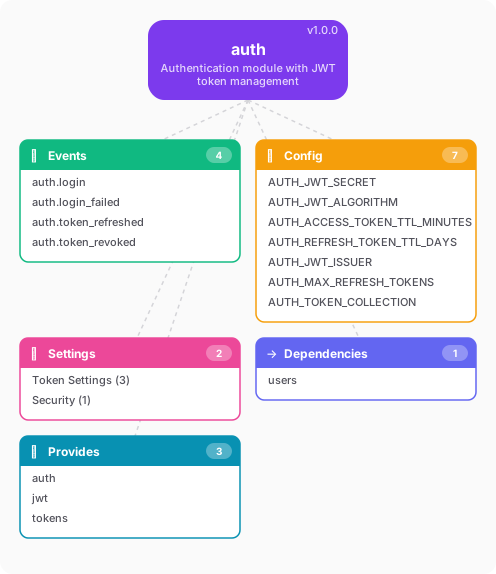
JWT authentication with refresh token rotation, OAuth2 password flow, and fine-grained middleware.
The auth module handles the complete authentication lifecycle — from login to token refresh to revocation. It supports both JSON and application/x-www-form-urlencoded (OAuth2 password flow) for the login endpoint, making it compatible with Scalar, Swagger UI, and any OAuth2 client.
Routes
| Method | Path | Description |
|---|---|---|
POST | /auth/login | Authenticate and receive access + refresh tokens |
POST | /auth/refresh | Rotate the refresh token |
POST | /auth/revoke | Revoke a refresh token |
Events
| Event | Trigger |
|---|---|
auth.login | Successful authentication |
auth.login_failed | Failed login attempt (bad credentials) |
auth.token_refreshed | Token successfully rotated |
auth.token_revoked | Refresh token revoked |
Middleware
// Require valid JWT on all routes in a group
r.Use(auth.AuthMiddleware)

// Optional — populate user context if token present
r.Use(auth.OptionalAuth)

// Restrict to superusers
r.Use(auth.RequireSuperuser)

// Check specific permission
r.Use(auth.RequirePermission("users.write"))
Configuration
| Variable | Default | Description |
|---|---|---|
AUTH_JWT_SECRET | required | Secret key for JWT signing |
AUTH_JWT_ALGORITHM | HS256 | JWT signing algorithm |
AUTH_ACCESS_TOKEN_TTL_MINUTES | 30 | Access token lifetime |
AUTH_REFRESH_TOKEN_TTL_DAYS | 7 | Refresh token lifetime |
AUTH_JWT_ISSUER | redelay | JWT issuer claim |
AUTH_MAX_REFRESH_TOKENS | 5 | Max active refresh tokens per user |
AUTH_TOKEN_COLLECTION | tokens | MongoDB collection for refresh tokens |
Cross-module integration
The auth module automatically discovers and integrates with:
- users module — as a
LookupProviderfor credential verification - groups module — as a
PermissionsProviderfor permission-based authorization
users
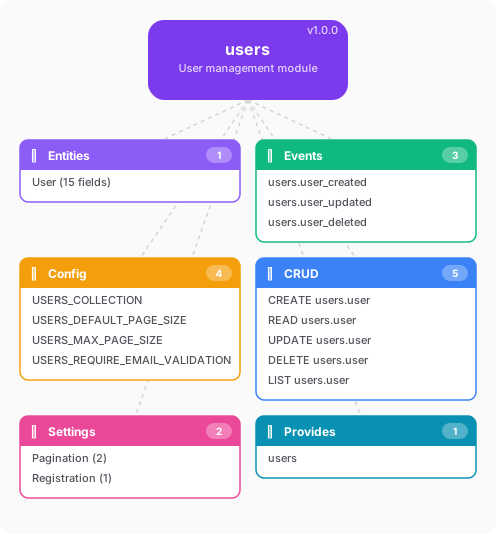
Full user CRUD with a rich 15-field entity, pagination, password hashing, and event emission.
The users module provides a complete user management system with create, read, update, delete, and list operations. Every mutation emits a typed event, making it easy to trigger downstream workflows.
Entity: User
| Field | Type | Description |
|---|---|---|
id | ObjectID | Unique identifier |
email | string | Unique, validated email address |
full_name | string | Display name |
first_name | string | Given name |
last_name | string | Family name |
is_active | boolean | Account active flag |
is_superuser | boolean | Superuser privileges |
email_validated | boolean | Email verification status |
totp_enabled | boolean | Two-factor auth enabled |
profile_picture | string | Avatar URL |
oauth_provider | string | External auth provider |
user_groups | string | Group membership IDs |
last_login_at | datetime | Last successful login |
created_at | datetime | Account creation time |
updated_at | datetime | Last modification time |
Routes
| Method | Path | Description |
|---|---|---|
GET | /users/me | Current user profile |
GET | /users/ | List users (paginated) |
POST | /users/ | Create a new user |
GET | /users/{id} | Get user by ID |
PATCH | /users/{id} | Update user |
DELETE | /users/{id} | Delete user |
Events
| Event | Trigger |
|---|---|
users.user_created | New user registered |
users.user_updated | User profile modified |
users.user_deleted | User account removed |
CRUD operations
All operations are declared in the module spec and support:
- Create — with password hashing and email uniqueness validation
- Read — single user by ID
- Update — partial updates with field-level validation
- Delete — soft or hard delete
- List — paginated with configurable page size
Configuration
| Variable | Default | Description |
|---|---|---|
USERS_COLLECTION | users | MongoDB collection name |
USERS_DEFAULT_PAGE_SIZE | 20 | Default pagination size |
USERS_MAX_PAGE_SIZE | 100 | Maximum allowed page size |
USERS_REQUIRE_EMAIL_VALIDATION | false | Require verified email |
groups
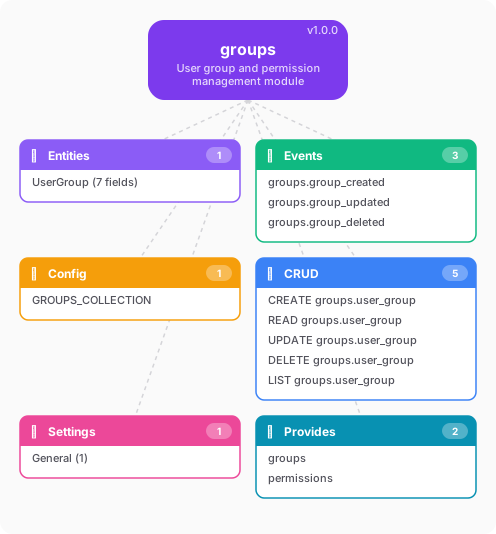
Role-based group management with permission resolution and user membership.
The groups module provides user groups with associated permissions. When combined with the auth module's RequirePermission middleware, it enables fine-grained role-based access control (RBAC).
Entity: UserGroup
| Field | Type | Description |
|---|---|---|
id | ObjectID | Unique identifier |
name | string | Group name |
description | string | Group purpose |
permissions | string | Permission strings (e.g., users.write) |
is_active | boolean | Group active flag |
created_at | datetime | Creation time |
updated_at | datetime | Last modification |
Events
| Event | Trigger |
|---|---|
groups.group_created | New group created |
groups.group_updated | Group modified |
groups.group_deleted | Group removed |
CRUD operations
Full CRUD with create, read, update, delete, and list — all with event emission.
Configuration
| Variable | Default | Description |
|---|---|---|
GROUPS_COLLECTION | groups | MongoDB collection name |
How permissions work
User → belongs to Groups → each Group has Permissions → auth middleware checks Permissions
// In your routes:
r.Handle("DELETE", "/{id}", handler,
    modules.Security("BearerAuth"),
    modules.RequirePermission("users.delete"),
)
health
Simple health check endpoint for container orchestration readiness probes.
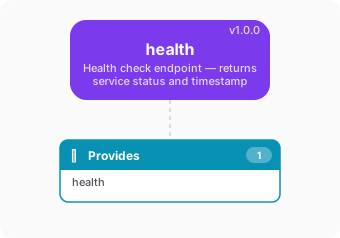
Returns a JSON response indicating the service is running and ready to accept requests.
curl http://localhost:8080/api/v1/health
# {"status": "ok"}
No configuration required. Ideal for Kubernetes readinessProbe and livenessProbe.
openapi
Auto-generated OpenAPI 3.0 spec with interactive API documentation UI.
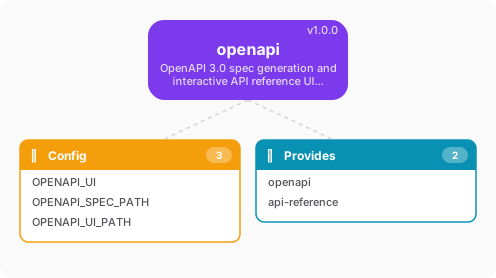
The OpenAPI module introspects all registered routes and their metadata (request bodies, responses, security requirements) to produce a complete OpenAPI 3.0 specification. It serves this spec as JSON and renders an interactive UI for exploring and testing the API.
Endpoints
| Path | Description |
|---|---|
/openapi.json | OpenAPI 3.0 spec (JSON) |
/reference | Interactive API documentation UI |
UI providers
Choose your preferred documentation interface:
| Provider | Setting | Description |
|---|---|---|
| Scalar | OPENAPI_UI=scalar | Modern, beautiful API reference (default) |
| Swagger UI | OPENAPI_UI=swagger | Classic Swagger interface |
| Redoc | OPENAPI_UI=redoc | Clean read-focused documentation |
| Disabled | OPENAPI_UI=disabled | JSON spec only, no UI |
How schemas are generated
Route handlers declare metadata using functional options:
r.Handle("POST", "/", handler,
    modules.Summary("Create user"),
    modules.Body(UserCreateInput{}),
    modules.Response(201, "User created", UserResponse{}),
    modules.Response(400, "Bad request", modules.RedelayErrorResponse{}),
    modules.Security("BearerAuth"),
)
The SchemaRegistry converts Go structs to JSON Schema using reflection:
jsontags → field namesvalidatetags → constraints (required, email, min, max)- Pointer types → nullable
time.Time→ date-time format- Slices, maps, embedded structs → proper schema composition
Configuration
| Variable | Default | Description |
|---|---|---|
OPENAPI_UI | scalar | UI provider selection |
OPENAPI_SPEC_PATH | /openapi.json | JSON spec path |
OPENAPI_UI_PATH | /reference | UI page path |
asyncapi
Auto-generated AsyncAPI 2.6 spec from all registered events, served with AsyncAPI Studio.
The AsyncAPI module is the event-contract equivalent of the OpenAPI module — it introspects
every module's Events() and Consumers() declarations to produce a complete
AsyncAPI 2.6 specification and serve an interactive UI.
Endpoints
| Path | Description |
|---|---|
/asyncapi.json | AsyncAPI 2.6 spec (YAML, Content-Type: application/yaml) |
/asyncapi | AsyncAPI Studio — interactive event browser |
How events become channels
Each ir.Event returned by a module's Events() method becomes an AsyncAPI channel:
Module.Events() → ir.Event{Name: "order.created", Topic: "order.created", Payload: ...}

asyncapi: "2.6.0"
channels:
  order.created:
    publish:
      operationId: order.created
      message:
        payload:
          $ref: '#/components/schemas/OrderCreatedPayload'
Consumer registrations produce subscribe operations with Kafka groupId bindings.
Payload packets with named fields produce components/schemas entries.
Configuration
| Variable | Default | Description |
|---|---|---|
ASYNCAPI_UI | studio | UI provider (studio or disabled) |
ASYNCAPI_SPEC_PATH | /asyncapi.json | YAML spec path |
ASYNCAPI_UI_PATH | /asyncapi | Studio UI path |
mcp
Model Context Protocol server with automatic tool discovery from registered modules.
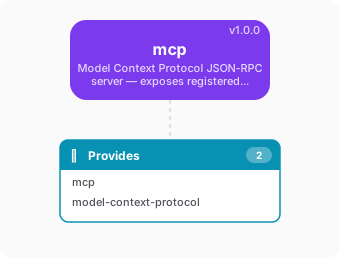
The MCP module exposes your framework's capabilities as tools that AI assistants can invoke. It speaks the MCP Streamable HTTP transport (protocol 2025-03-26) — compatible with VS Code, Claude Desktop, Cursor, and other MCP clients.
Endpoint
| Method | Path | Description |
|---|---|---|
POST | /mcp | MCP JSON-RPC endpoint (Streamable HTTP transport) |
What gets discovered
- Introspection tools (9) —
list_modules,describe_module,list_flowdsl_nodes,describe_flowdsl_node,list_events,describe_event,list_packets,describe_packet,search_redelay - Developer tools (5) —
validate_flowdsl,validate_module,scaffold_module,list_api_routes,explain_flowdsl_node - Route tools — every HTTP route from
RoutesProvidermodules becomes a callable tool - Module-contributed tools — any module implementing
MCPProvidercontributes its own tools and resources
Extending MCP from your module
Implement MCPProvider to contribute tools:
func (m *Module) MCPTools() []modules.MCPTool {
    return []modules.MCPTool{
        {
            Name:        "my_tool",
            Description: "Does something useful for AI assistants",
            InputSchema: map[string]any{
                "type": "object",
                "properties": map[string]any{
                    "query": map[string]any{"type": "string"},
                },
            },
            Handler: func(ctx context.Context, args map[string]any) (any, error) {
                // your logic here
                return result, nil
            },
        },
    }
}

func (m *Module) MCPResources() []modules.MCPResource { return nil }
Your tools appear in tools/list as soon as your module is blank-imported.
IDE setup
Add to .vscode/mcp.json:
{
  "servers": {
    "my-app": {
      "type": "http",
      "url": "http://localhost:8000/mcp"
    }
  }
}
modspec
Interactive module spec browser with SVG diagrams and YAML definitions.
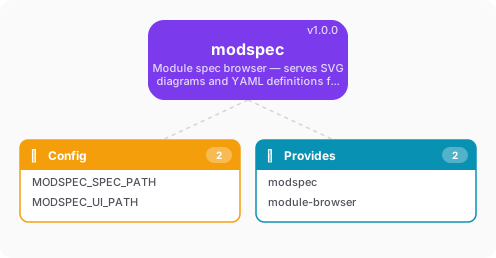
The modspec module provides a visual overview of all registered modules — similar to how the OpenAPI module provides interactive API reference.
Endpoints
| Path | Description |
|---|---|
/modules.json | JSON array of all module specs (includes SVG + YAML) |
/modules | Interactive HTML browser with diagrams |
Features
- Module cards — expandable panels for each registered module with badges showing route/event/consumer counts
- Routes tab — color-coded HTTP method badges with full paths (sourced from OpenAPI route discovery)
- Events tab — list of published events with topic and description
- Consumers tab — list of consumed topics with consumer group IDs
- SVG diagrams — auto-generated visual diagrams showing entities, events, config, CRUD, settings, and dependencies
- YAML specs — full module definition with copy button
- Top nav links — quick links to
/reference(OpenAPI UI) and/asyncapi(AsyncAPI Studio) - Dark mode — automatic theme switching
- Zero external dependencies — fully self-contained HTML page
modules.json schema
The /modules.json endpoint returns a JSON array, with each entry including:
{
  "name": "auth",
  "description": "...",
  "version": "1.0.0",
  "routes": [
    { "method": "POST", "path": "/api/v1/auth/login", "summary": "Login" }
  ],
  "events": [
    { "name": "auth.login", "topic": "auth.login", "description": "Successful authentication" }
  ],
  "consumers": [],
  "svg": "...",
  "yaml": "..."
}
Configuration
| Variable | Default | Description |
|---|---|---|
MODSPEC_SPEC_PATH | /modules.json | JSON spec path |
MODSPEC_UI_PATH | /modules | UI page path |
OPENAPI_UI_PATH | /reference | OpenAPI UI link in the top nav |
ASYNCAPI_UI_PATH | /asyncapi | AsyncAPI Studio link in the top nav |
ROUTE_PREFIX | /api/v1 | Prepended to route paths in the UI |
Module dependency graph
The built-in modules form a clean dependency tree:
auth ──→ users (credential lookup)
  │
  └──→ groups (permission resolution)

openapi  ──→ reads route metadata from all modules     → /openapi.json + /reference
asyncapi ──→ reads event/consumer IR from all modules  → /asyncapi.json + /asyncapi
mcp      ──→ discovers tools from all modules          → /mcp
modspec  ──→ reads IR + routes from all modules        → /modules.json + /modules
                (links to openapi + asyncapi UIs)

health (standalone)
Every module is optional — import only what you need. Dependencies are resolved automatically at bootstrap.
The three spec layers
| Spec | Path | Covers |
|---|---|---|
| OpenAPI | /openapi.json + /reference | HTTP routes, request/response schemas, security |
| AsyncAPI | /asyncapi.json + /asyncapi | Event channels, message schemas, consumer groups |
| ModSpec | /modules.json + /modules | Module architecture — entities, CRUD, config, settings, flows; links to both above |
Creating custom modules
See the Creating a Go Module guide and the Module Definition Files reference for defining your own modules with YAML specs, JSON Schema validation, and auto-generated diagrams.
Go Framework
Full reference for the redelay go-framework — module system, auth, users, groups, CRUD, server, and infrastructure.
Domain Addon Modules
Domain addon modules: scheduler, settings, storage, notifications, verification, links, metrics, search, i18n, apilog, content, workers, coordination, websockets, and flowexec.